Unknown's avatar

About drglenndavies

Dr Glenn Davies is a teacher, author, republican activist, and historian. In any spare time, which seems increasingly rare, he is an occasional science fiction writer and reviewer, and has been an Aurealis Award Science Fiction Short Story Judge. He believes strongly in the epithet ‘publish or perish’ – no matter how constant and demanding the teaching load, it is vital, as historians, to be writing.

‘The Tetralogy of Jono’ is now complete

The publication of Brisbane writer Harry Colfer’s Show Cause completes ‘The Tetralogy of Jono’. That’s a four-book series, if you’re wondering. Independent Australia History editor and fan of all Brisbane stories Dr Glenn Davies interviewed Colfer on what drove him to write his novel series and why fiction is the only way to explain the reality of life as a paramedic.

Harry Colfer is the pseudonym of an experienced practising critical care paramedic with twenty years of on-road experience gained in both England and Australia. Although his stories are total fiction, Colfer’s writing style is very realistic. Colfer now lives and works in Brisbane.

In 2012, as a way of dealing with his inevitable demons after more than a decade on the road, Colfer took the advice of his wife and embraced the cathartic paramedic custom of dark-humoured storytelling and began writing in his spare time.

All paramedics have a story to tell. These are Harry’s.

On 27 March 2021 I wrote a review of Dead Regular, the first novel in Harry Colfer’s Brisbane-based ‘Jono Series’; a novel at the forefront of a new genre – paramedic procedural. In Dead Regular we got our first glimpse at seeing what it is like to work as a paramedic.

A few months shy of four years later, Harry Colfer has just released Show Cause, the final instalment in what has become known as ‘The Tetralogy of Jono’ with the tag line: If you ever earn an enemy, best not make it a psychopath.

Harry Colfer’s ‘The Tetralogy of Jono’ novels feature the same main protagonist, fictional Brisbane-based paramedic Jonothan ‘Jono’ Byrne, as well as his collection of quirky colleagues and familiar characters who continue within his orbit throughout the series of books as they roar around the streets of Brisbane.

The first novel, a murder mystery called Dead Regular, published in 2020, introduced us to paramedic ‘Jono’ Byrne, who believes a serial killer is offing his regular patients. When he starts speaking out, ‘Jono’ is framed for murder and goes on the run to clear his name.

The second novel, an action thriller called Beneath Contempt, published in 2021, follows ‘Jono’ to Mornington Island in the Gulf of Carpentaria where he has been transferred and becomes embroiled in a people-smuggling operation using the island as a base.

The third novel, High Acuity, published in 2023, involves ‘Jono’ returning to Brisbane and uncovering a terrorist plot to use an ambulance as an excuse to board a plane. It takes place over 13 hours, with each chapter assigned a time stamp, alternating between different characters’ points of view.

The fourth and final novel, a mystery thriller called Show Cause, published in December 2024, sees ‘Jono’ Byrne back working as a paramedic on the streets of Brisbane, living on his yacht in Newport Marina. Everything in his world is looking up, but then his friend, DS Frank Giallo, provides him with an update from Interpol, and ‘Jono’s’ PTSD nightmares return with a vengeance. Soon after, his life enters free fall, and he wonders if the cause is just an unfortunate sequence of events, or has his nemesis returned to seek revenge?

Using his knowledge of the paramedicine subject area, Colfer created a series of short stories,Ambo Tales from the Frontline, eventually publishing one for each of the thirty-two codes used to categorise emergency calls. Initially each short story was progressively released as an individual e-book, but on completion of the series six years later in 2022, he self-published the book compendium as The Complete Collection.

Harry Colfer describes it as a long and tiring slog. After writing the first six short stories, he realised the mammoth task ahead of him.

I thought, great, I’ve got six, I’ve only got 26 to go. But I didn’t do the maths on it because 32 times four-or-five thousand-word short stories is about 150,000 words, which was two novels worth of writing to get done. That’s massive.”

All the Ambo Tales were prequels to Dead Regular, the thriller Colfer had begun years earlier in 2012.

In the interim, Colfer took home three successive Kennedy Foundation’s SD Harvey Short Crime Story awards, two for the already published short stories (“Number 27: Stabbing” and “Number 30: Traumatic injury”) and another he penned specifically for the competition under his own name. He was also shortlisted and longlisted for numerous other awards, including being a finalist in America’s prestigious Indie Book Awards.

With his role being one of the highest trained pre-hospital clinicians, Harry Colfer (in his non-pen name persona) regularly attends cardiac arrests, multi-system trauma and major incidents. Although Colfer’s stories are fictional, the clinical details and interventions are all accurate, thereby giving the reader an entertaining education in the frontline emergency world. Beyond this, his main protagonist, ‘Jono’, often says and does the things Harry wishes he could get away with, and that’s perhaps why he goes by his pen name.

Do I look the part?

https://www.facebook.com/reel/757509072789082https://www.facebook.com/reel/757509072789082

Fake Gordon

https://www.facebook.com/harry.colfer.1/videos/1603351327089733

Harry Colfer’s excellent descriptive prose and his fantastic use of Australian metaphors makes it easy for any reader to enter the fictitious yet very believable world of ‘Jono’ and his professional life working for the Brisbane City Ambulance Service.

This is craft fully written, at times beautiful in its descriptions, at times downright Tarantinoesque in its sense of humour for viscera, and yet at the same time a real page turner, with plots that rocket along as fast as the Code 1 drives that the Ambo’s do. It’s an insider’s view of the emergency world that only a few people ever really get to see.

The quirky references to Brisbane streets and locations were delightful treats to those who can relate and beautifully anchors the series in the streets of Brisbane. The style is easy to read and brilliantly captures the quick-witted banter and sledging that is a common culture of such close, mission-critical teams.

Colfer has a remarkable way of bringing characters into full-blown three-dimensional light. Certainly, no flat characters here. Fully developed, ‘Jono’ and his crew mates take you on a full-tilt journey throughout the novel series not only into the world of Brisbane Ambos but also by engaging murder, action, terrorist, and mystery plots, even with a little romance. Full of unexpected twists that kept me guessing right to the very end of each book, these stories made me laugh throughout and even cry on a couple of occasions.

The point has to be made that Colfer’s ‘Jono’ character shares a name with another Brisbane literary character. David Malouf’s semi-autobiographical novel Johnno is set in Brisbane in the 1940s and 1950s. His characters Dante and Johnno grow up in the bustle of steamy, wartime Brisbane. Later, as teenagers, they learn about love and life amidst the city’s pubs and public libraries, backyards and brothels, Moreton Bay figs, and tennis parties.

Malouf delights in describing his hometown, Brisbane: the shady verandahs where daytime visitors were entertained, the nearby river with its mudflats and mangrove swamps, summer storms on tin roofs – and always the heat, references to the sticky, humid Brisbane heat.

In recent conversation with Harry Colfer, he acknowledges the stories featuring ‘Jono’ are loosely based on his own, albeit set in a fictional ambulance service. It seems Malouf’s Johnno and Colfer’s ‘Jono’ are both semi-autobiographical Brisbane characters separated by about 70 years.

There have been other Brisbane storyteller’s who’ve used a sense of place as a distinct character, such as Hugh Lunn’s, Over the Top with Jim. However, in the 1990s, the release of three iconic books revolutionised perceptions of Brisbane as a place. All three books explored contemporary local Brisbane life, but through different lenses: Andrew McGahan’s Praise, shows a grungy, seedy version of Brisbane; Nick Earl’s Zig Zag Street is for those who hated their jobs; and John Birmingham’s He Died With a Felafel in His Hand is a knock-about comedy that was required reading for anyone who lived in a Brisbane share house in the 1990s.

More recently, Trent Dalton’s 2019 Boy Swallows Universe set in the suburb of Bracken Ridge, northern Brisbane in the 1980’s, also resonates with a strong sense of place.

At his 2024 Brisbane Writers Festival book talk, US crime fiction author Michael Connelly, creator of the LAPD Detective Hieronymous ‘Harry’ Bosch character, said that as a young writer in the 1970s he voraciously read Raymond Chandler crime novels, over and over again. Harry Colfer shared with me he did the same with Michael Connelly crime novels. Connelly spoke about how he considers Los Angeles a main character in his books. Harry Colfer has done the same with Brisbane in his ‘Jono’ paramedic crime fiction series.

Although Colfer is emulating his literary hero Connelly in making Brisbane a main character in his ‘The Tetralogy of Jono’ novel series he joins a long line of Brisbane’s famous authors.
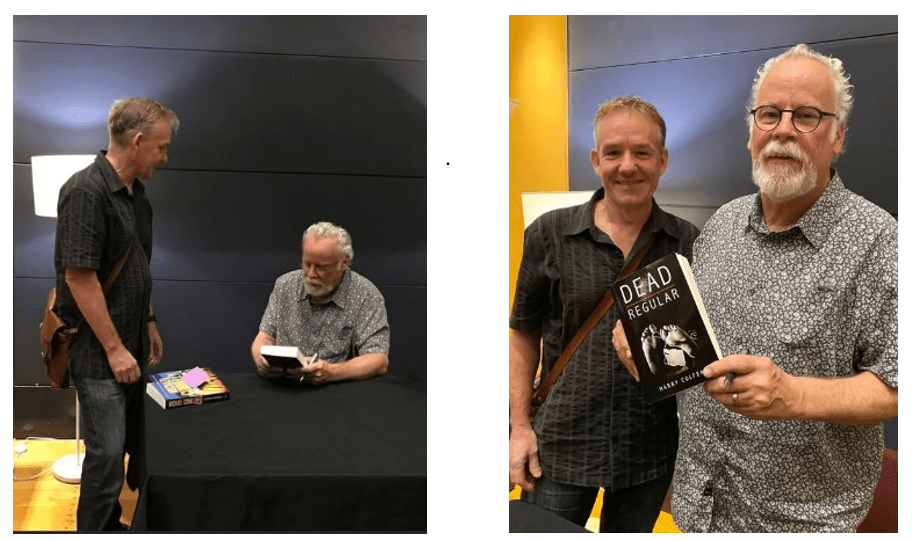
Harry Colfer fanboying US crime fiction author Michael Connelly at 2024 Brisbane Writers Festival book talk.

Harry Colfer is definitely an author with a winning, distinct style. His ‘The Tetralogy of Jono’ is a truly Australian series. He may be laying down his pen and no longer writing about ‘Jono and his crew’

roaring round and round, up and down, through the streets of your town

but there is no doubt he is an author worth watching to where he goes next.
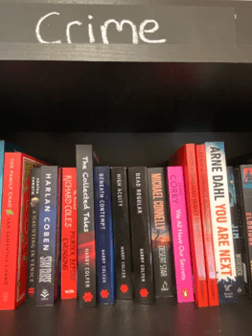
Good Reads reviews

Dead Regular: https://www.goodreads.com/book/show/55843965-dead-regular

Beneath Contempt: https://www.goodreads.com/…/show/59350767-beneath-contempt

High Acuity: https://www.goodreads.com/book/show/201103095-high-acuity

Ambo Tales From The Front Line collections reviews
Collection 1 – https://www.goodreads.com/book/show/36533156-collection-1  
Collection 2 – https://www.goodreads.com/book/show/58557854-collection-2
Collection 3 – https://www.goodreads.com/book/show/75517990-collection-3

You can hear Harry Colfer at ‘The Genre Fiction Podcast’: http://www.youtube.com/@GenreFictionPodcast

You can read samples of all Harry Colfers books at https://harrycolfer.com/read-for-free/
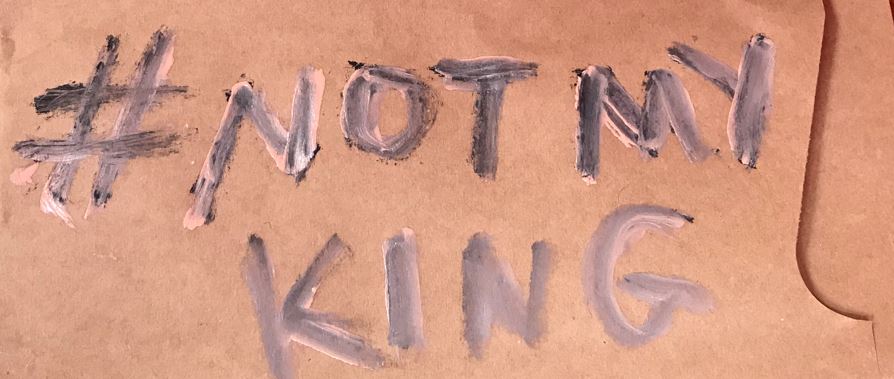
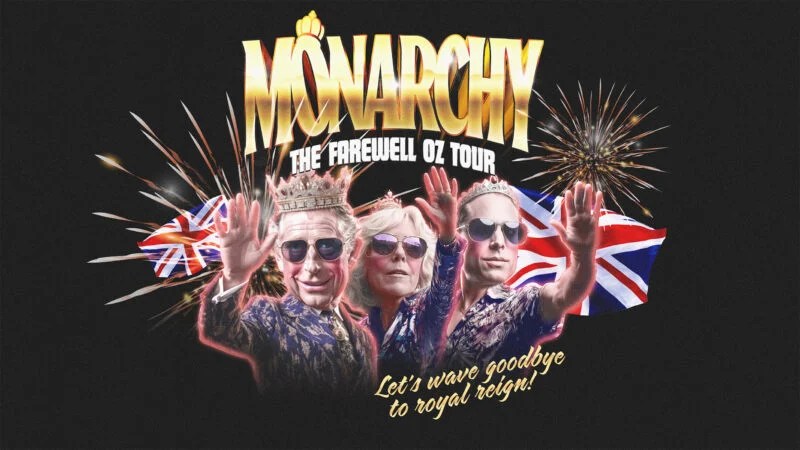
Aussies are still girt by monarchy

So, KCIII has finally turned up. King Charles III has finally undertaken the Australian leg of his victory lap of the Commonwealth. Surely it’s time for an Australian head of state to be not only one of us but also resident and present.

It’s been over two years since the then Prince Charles stepped into the top job. This all changes between 18th and 26th October 2024 and marks the first time Australians have had a royal audience with their own king.

After over ten years, four governors-general and two monarchs, a sitting Australian Head of State is headed Down Under!

Our absentee King’s 17,000km journey from the other side of the world will see Charles and his wife, Queen Camilla grace us with the presence of the British monarch on Australian soil for the first time as our Head of State (although the grace will be presented only in Sydney and Canberra).

Next Monday, King Charles III will be greeted in Canberra by the prime minister, but not a single state leader who have all declined their invitations, citing “other commitments” ranging from election campaigns to cabinet meetings.

It was less than two weeks ago that Queensland had its second King’s Birthday Public Holiday, even though KCIII’s actual birthday is 19 November. Queenslanders took the day off work; not in recognition of their hard work, but to recognise the British Monarch who will most likely be sleeping through our public holiday.

The King’s Birthday Public Holiday doesn’t remind us of anything good about our country. At worst, it tells us Australia’s head of state gets the job by inheritance.

You would’ve thought it would have been better if the British monarch had turned up for his own birthday weekend? I suppose though it would have been awkward: public holiday in Queensland only at this time of year (with WA a week before) and Queensland not even on the visiting schedule. Oops.

The lack of any public activity around the King’s Birthday Public Holiday shows also how the concept of monarchy is out-of-step with contemporary Australia. 

Since his birth as Prince Charles, KCIII has known he would take over the top job. Then one morning in 2022, Australians simply woke up to hear news from Britain that has changed our country for decades to come.

Australians did not choose King Charles III as our Head of State. It is a disgraceful fact that without constitutional change, the citizens of Australia will never be consulted on our head of state.

It’s time for an Australian to be our head of state and do the job full-time, rather than working from home at Windsor Castle where they can’t even be bothered Zooming into the Australian office at least once a week.

We are a unique multicultural country and we need someone who understands how to embody us, to be the guardian of our Constitution, to be a unifying symbol at home and someone we are proud to see representing us abroad. They should be elected on merit, not gifted the position by birthright. They should have the skills and work experience to do the job.

The person should be one of us, responsible and accountable to us, and unwaveringly loyal to us and only us.

We have our own identity as Australians. The Royals represent Britain, but cannot represent us or unite us as Australians. Australians believe in freedom and equal opportunity, not that some are born to rule over others.

We come from all walks of life, from all corners of the globe and this ancient land. Our shared commitment to our common future is what binds us together. Standing against this is the elevation of Charles III.

I’ve argued previously, there is no place for princes and kings in modern Australia. The public repudiation of previous Prime Minister Tony Abbott’s knights and dames decision showed that Australia has moved on from the old colonial way of thinking.

We can have respect and affection for Britain and its celebrity royals but still question why we do not have our own head of state. The royals are welcome to visit as representatives of Britain, but I look forward to when the British people and their royal family will welcome a visit by the first Australian head of state.

In the words of Sammy J:

So to our King, we say g’day and we praise his DNA, his ever-loyal subjects across the sea.

We might have golden soil and a bit of wealth for toil, but us Aussies are still girt by monarchy.

For us in Australia, royalty only ever visits us from somewhere else, from across the seas. It’s not something that lives with us. Royalty comes and royalty goes, but it is never a part of us.

Thanks Charles, but we’ve got it from here.

Toodle pip.

A Century of Compulsory Voting in Australia

Today, Australia clocks up a century of compulsory voting. Over this time compulsory voting has come to be seen as a community event; a common, civic enterprise – and one in which Australians are happy to participate, even if it is compulsory. We should celebrate how special compulsory voting has made our democracy, writes history editor Dr Glenn Davies.

I love election days – the pageantry, people, and smell of sausages. In Queensland, we will be having our next state election on 27 October 2024. On Election Day, I usually help run the P&C sausage sizzle in the mornings and hand out ‘how to vote’ cards in the afternoon. It’s a great chance to see the ebb and flow of your local community — and catch up with people you haven’t seen in ages. Election Day is a community event; a common, civic enterprise — and one in which most people are happy to participate.

Australia has been acknowledged in the past to be the world’s democratic laboratory. We pioneered the secret ballot (known elsewhere as the Australian ballot), universal adult suffrage, and popularly elected upper houses. We are also one of the few English-speaking nations to have mandatory voting, and people widely support it. Basically, Australia is one of the few nations in which voting is considered both a right and a duty – and the only Commonwealth Nation.

While compulsory voting was first advocated at the federal level by Alfred Deakin at the turn of the twentieth century, Australia’s first nine federal elections were held under voluntary voting. At the federal level, voluntary voting had produced between 55 per cent and 78 per cent turnout of voters.

It was in July 1910, that the then Labor Prime Minister, Andrew Fisher (a Queenslander) moved elections to Saturdays. This was of great assistance to Australian workers, who could then participate in elections. During the Federal parliament debate for the bill on compulsory enrolment in 1911, Senator George Pearce stated:

“Too often [voting] is looked upon merely as a privilege, because people throughout the world have had to fight for it — in some instances under distressing conditions … but I venture to say that in a country like Australia, where we recognise that every man and woman should have the right to vote, that right becomes more than a privilege — it becomes a duty.”

Soon after, in 1911, compulsory registration was introduced.

On 27 March 1912, Australia introduced compulsory enrolment and, in 1914, the uniformly disliked Queensland Premier Denham legislated compulsory voting in an attempt to gain middle-class non-unionised vote for the 1915 election. Apparently, the State Government was concerned that ALP shop stewards were more effective in “getting out the vote” and that compulsory voting would restore a level playing ground. Interestingly, the introduction of compulsory voting in Queensland in 1914 became the first place in the then British Empire to do so. However the result was not what Denham planned. The first compulsory poll saw an electoral swing to Labor all over Queensland, with the election of the second Queensland Labor Government, led by TJ Ryan, and the loss of Deham’s own seat.

The significant impetus for compulsory voting at federal elections appears to have been a decline in turnout from more than 71 per cent at the 1919 election to less than 60 per cent at the 1922 election.

On 24 July 1924, Tasmanian Senator Herbert Payne introduced the Commonwealth Electoral Bill 1924 as a private member’s bill to amend the Commonwealth Electoral Act 1918 to make voting compulsory in federal elections. Payne felt some action was required following the record low voter turnout (59.38 per cent) at the 1922 federal election. However, neither the government nor the opposition had compulsory voting on their platforms. Intriguingly, the law to make voting compulsory apparently passed through the Parliament in only 15 minutes and in neither house was a division required — therefore, no votes were recorded against the bill. This was only the third private member’s bill to be passed into law since 1901. Senator Payne explained the principle behind his Bill:

“The presumption is that our laws are enacted by a majority of the electors represented by a majority of the members in this Parliament.”

The impact of the new Bill was immediate, with turnout at the 1925 election rising to over 91%. After this, other states quickly followed: Victoria in 1926, New South Wales and Tasmania in 1928 and Western Australia in 1936. South Australia added compulsory voting for its House Assembly in 1942..

Since the federal election of 1925 voter turnout has never been below 90 per cent and, while the number of informal votes can vary, there is little evidence about what extent this represents acts of error, apathy or protest.

Strong and effective democracy requires a minimum degree of participation by all its citizens, not just those anxious to influence the system to get something out of it. The idea is not new. The Greek historian, Thucydides, recorded the Athenian leader Pericles as saying:

‘… we do not say that a man who takes no interest in politics is a man who minds his business: we say he has no business here at all.’

The decisions of government affect everyone and they are more likely to be made on behalf of everyone if everyone plays at least some role in selecting the members of Parliament.

Since 1924, participation in the voting process has become an accepted and entrenched activity in Australian society.

Compulsory enrolment and voting are the fundamental underpinnings of Australia’s democracy and Australians have readily accepted this with their enthusiastic participation in the electoral process. Participating in democracy should not be optional. Even if you despise politicians and the political process, turning out a couple of times every three or four years to vote for your local, state or national government is not burdensome for anyone. It forces even the most cynical individual to at least cast a fleeting glance at the political process and that is a desirable outcome.

The benefits of compulsory voting are stunning, including the consistently delivered voter turnout of more than 90%, among the best in the world and routinely 30% higher than voluntary systems. This translates into a politics that better targets the whole community. Perhaps the most important and surprising feature of compulsory voting is its popularity. Support for compulsory voting has been around 70% for half a century and has rarely dipped.

Australia has the oldest, and probably the most efficient, system of compulsory voting of any of the advanced democracies — and there is evidence of strong popular support for compulsory voting. Every opinion poll taken since 1943 has found that three in every four Australians support compulsory voting. This has always crossed party lines.

The first Australian Election Study, after the 1996 election, showed 74 per cent of respondents supported compulsory voting at federal elections; and the Australian Election Study after the 2004 election was still showing 74 per cent in support. A Morgan poll in 2005 showed 71 per cent support; and an Ipsos-Mackay Study, also in 2005, showed 74 per cent. Adelaide University’s Lisa Hill suggests:

‘…this is probably a function of the fact that their relationship to the state has normally been a friendly one.’

Australians have not looked upon the compulsion to vote as particularly objectionable or onerous. Most Australians regard voting not so much as a right but as a fairly undemanding civic duty. Voting is far less onerous than other compulsory civic duties — such as paying taxes, sending your children to school and jury duty. It is seen as a normal part of Australian political culture and has wide support in the Australian electorate.

Yes, it’s true, that compulsory voting forces people to engage with their democracy. But our democracy needs more occasions such as election day where we get together and engage in a shared activity. For the most part, this should not be as a result of compulsion. However, there is room for at least one occasion, held every few years, when all citizens are required to come together in a common, civic enterprise. The requirement that we turn up to vote meets that test.

It’s important to remember on this day, one hundred years later, that our robust and stable democracy is founded in our hard-won civic duty to participate in the voting process.

Dame Nellie Melba’s 1909 Back Blocks Tour (NSW & QLD) – Charters Towers performance

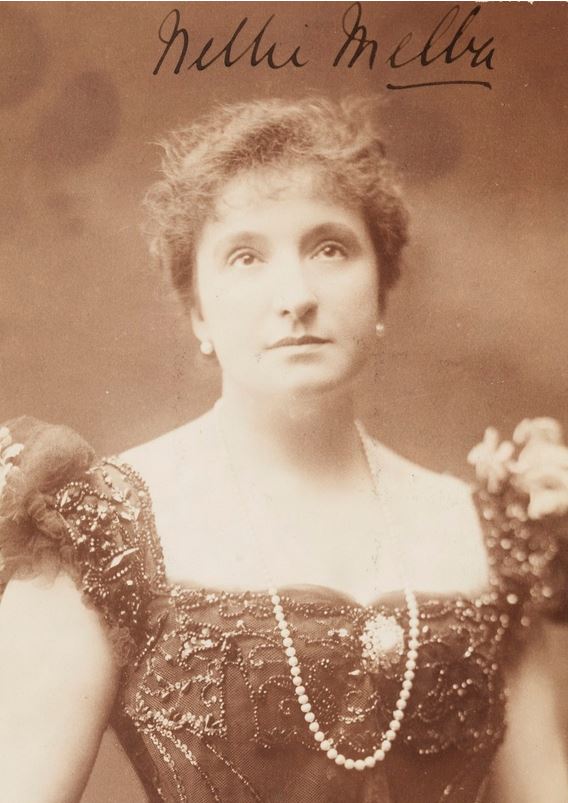
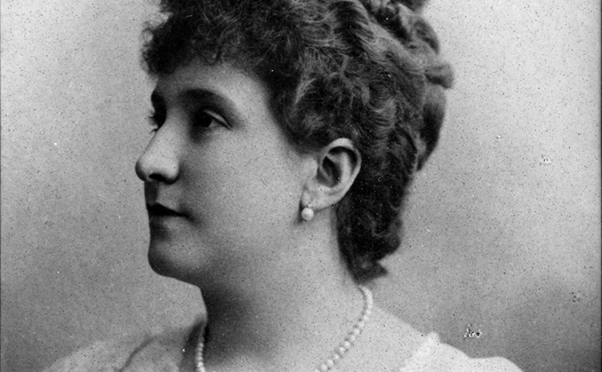
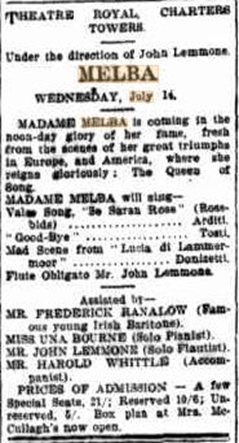
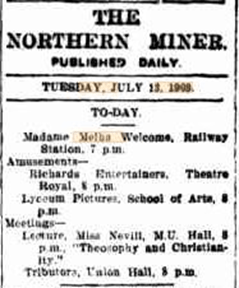
Today, 115 years ago, on 14 July 1909, Dame Nellie Melba performed at Charters Towers during her 1909 Back Blocks Tour (New South Wales and Queensland).

Australia has produced many singers of world renown, but none are more famous than the incomparable Dame Nellie Melba. She was unquestionably Australia’s most famous woman in her lifetime.

Melba dubbed her 1909 Australian tour her ‘sentimental tour’. It helped establish her reputation as an international star who also performed for her home crowd. Melba travelled by train across Australia, covering some 16,000 kilometres, performing in remote towns as well as cities.

The further she toured, the deeper seemed the adulation: there were banquets, speeches, even small crowds at wayside stations as Melba progressed with an entourage consisting of her manager, a maid and a valet, together with two baby grand pianos.

Dame Nellie Melba was regularly met by crowds at the railway stations and many of the towns she visited held banquets to show their support for Australia’s ‘Queen of Song’.

The public loved Melba and she equally loved their adoration.

The 1909 Back Blocks Tour began in Forbes on 8 June 1909 and travelled through Orange, Bathurst, Dubbo, Sydney, Maitland, Tamworth, Armidale, Glen Innes, Brisbane, Rockhampton, Mount Morgan, Rockhampton, and on 12 July 1909 performed in Townsville. The next stop for her tour was Charters Towers.

She would always arrive a full twenty-four hours before a performance, and to sustain the excitement give her concert without an interval.

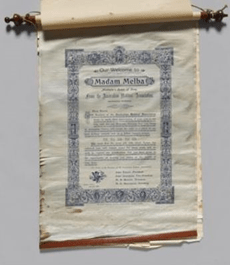
On her arrival in Charters Towers on 13 July 1909, Melba was presented with a Blue Silk Scroll by the Charters Towers branch of the Australian Natives’ Association (ANA). The silk scroll was hung on an ornate wooden rod and made by the Martin Smith Printers, Charters Towers.

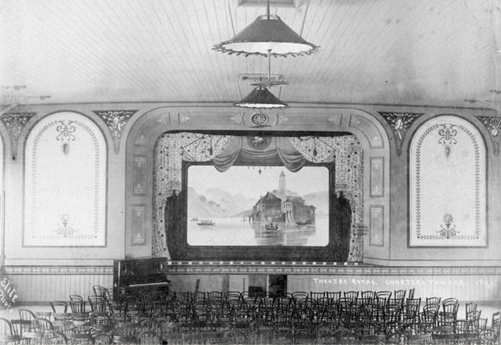
Dame Nellie Melba performed in the Theatre Royal at the corner of Church and Hodgkinson Streets. The Theatre Royal was the largest place of entertainment in Charters Towers and held upwards of 2000 people.

The main entrance to the theatre was via Hodgkinson Street frontage but there were two or three wide doorways opening onto Church Street as well. The dressing rooms were located at the northern end of the building under the stage area.

The 1909 Melba performance established a record for the theatre.

After the Charters Towers performance, the 1909 Back Blocks Tour went back to Townsville for a second performance, and then on to Bundaberg, Maryborough, Murwillumbah, Lismore, Casino, Brisbane, Toowoomba, Sydney, Cootamundra, Narandera, Wagga Wagga, and finishing in Albury, NSW on 6 September 1909.

This was a major event 115 years ago.

Palm Sunday is fundamentally a day of protest

Palm Sunday is a traditional day of protest for peace. During the 1980s, Palm Sundays in Australia were the occasion for enormous anti-nuclear rallies across the country.

THE PALM SUNDAY peace march is an annual ecumenical event that draws people from many faith backgrounds to march for nonviolent approaches to contentious public policies. The event has a rich history.

While the rallies have focused on different issues over time, shifting as different issues arise, the Palm Sunday peace march has been a constant over several decades.

The event is based on the account of Jesus’ procession into Jerusalem. Recorded in all four gospels, the narrative sees Jesus enter the city on a donkey, an action considered by many as a piece of anti-imperial political theatre, a demonstration designed to mock the obscene pomp of the Roman empire. Today, Christians commemorate the event with the movable feast Palm Sunday on the Sunday before Easter.

Australia has seen some large protest marches in the past. At the first Vietnam War moratorium protest in May 1970, 70,000 people marched in Melbourne and 20,000 in Sydney.

The annual Palm Sunday rallies were organised by the People for Nuclear Disarmament, beginning in 1982 and reaching a peak in 1985. On Palm Sunday in 1982, an estimated 100,000 Australians participated in anti-nuclear rallies in the nation’s biggest cities. These rallies grew year by year.

1984 was the year of George Orwell’s dystopian future — though the 1980s was less about a surveillance society than nuclear fear. In 1984, Labor introduced the three-mine policy as a result of heavy pressure from anti-nuclear groups. This was also a time when many Australians were concerned that the secret defence bases at Pine Gap, North West Cape and Nurrungar, run jointly with the United States on Australian soil, were “high priority” nuclear targets

An estimated 250,000 people took part in Palm Sunday peace marches in April 1984 and the Nuclear Disarmament Party gained 7 per cent of the vote in the December 1984 election and won a Senate seat. In addition, the election of the Lange Labor Party Government in New Zealand in July 1984 resulted in New Zealand banning visits by ships that might be carrying nuclear weapons.

Australia did not follow the example of New Zealand and refused entry to any ship that carried nuclear weapons, which were also considered targets in a nuclear war. The refusal of New Zealand to permit a visit by the USS Buchanan in February 1985 threatened the future of the ANZUS alliance.

In 1985, more than 350,000 people marched across Australia in Palm Sunday anti-nuclear rallies demanding an end to Australia’s uranium mining and exports, abolishing nuclear weapons and creating a nuclear-free zone across the Pacific region. The biggest rally was in Sydney, where 170,000 people brought the city to a standstill.

In May 2000, there were around 250,000 people who walked across Sydney Harbour Bridge in support of reconciliation.

On 15 February 2003, there were protest marches all around Australia in capital cities, many major cities and towns demonstrating against involvement in the Iraq war. The estimate for participation around Australia was just over 1,000,000 people.

350,000 students and workers undertook a climate strike in 2021 in over 115 Australian cities and towns, and more recently the sustained weekly mass protests in support of the Palestinian people.

During the 1950s and 1960s, the United States and the USSR accused each other of wanting to dominate the world. Nuclear weapons were used as a form of security. The more the U.S. built, the more the USSR built. The destructiveness of nuclear weapons is immense. The policy of Mutually Assured Destruction (MAD) was that the more a country had, the less likely it was to be attacked. Many Australians did not believe in the policy of MAD.

The apocalypse figured heavily in 1980s social life.

The song “London Calling” from the 1979 album of the same name by UK punk band The Clash is an apocalyptic, politically charged rant that reflected the concern about world events with reference to “a nuclear error” and the incident at Three Mile Island, which occurred earlier in 1979.

From 1980 to 1988, the U.S. President was Ronald Reagan – a better actor in office than he ever was on screen – who co-opted the language of science-fiction for his proposed anti-ballistic system, the Strategic Defense Initiative. This proposal was known as “Star Wars” — a machine that would protect humanity from itself.

The popular view was that the stumbling hand of Ronald Reagan perpetually hovered over the nuclear kill switch. During the early and mid-1980s, many Americans rallied to the Reagan administration’s policies, particularly increased spending. During this time, popular pro-nuclear, pro-Reagan films existed such as Red Dawn where on a peaceful morning in mid-western America, through the windows of a high-school classroom, students see Soviet paratroopers land on their football field starting the invasion of the United States.

Red Dawn was released in the same year Arnold Schwarzenegger frightened everyone with the nightmare vision of an apocalyptic future after the world had been destroyed in The Terminator. Science fiction gives insights into the sources, dangers and dimensions of the nuclear menace. In films dealing with post-nuclear scenarios, humankind must survive if there is to be any story at all.

At the same time that Americans flocked to the Reagan platform, more Americans watched the city of Lawrence, Kansas suffer the effects of a fictitious nuclear war in The Day After. The controversial 1983 movie portrays the grim reality of what a nuclear war looks like and its aftermath of social chaos and economic collapse. During the Cold War, it was theorised that Lawrence, Kansas would be one of the few cities completely unaffected by nuclear war as it is near the exact geographic centre of the United States.

The Day After was a dramatisation of the effects of a hypothetical nuclear attack on the United States and was one of the biggest media events of the 1980s. The Day After aired on U.S. TV on Sunday, 20 November 1983 on the ABC television network and was watched by an estimated half the adult population, nearly 100 million, the largest audience for a made-for-TV movie to that time and making the film one of the most successful television broadcasts.

The airing of The Day After on U.S. TV was a defining moment in the Cold War in that it took human extinction to the individual level. The Cold War attitude towards nuclear proliferation stopped cold in its tracks. The people of the world could now visualise what a nuclear attack would look and feel like — and they didn’t like it.

The song ’99 Luftballoons’ is a Cold War-era protest song by the German singer Nena. It reached number one in West Germany in 1983 and the original German version peaked at number two on the American Billboard in 1984.

Then, starting on 28 February 1984, Nena topped the UK Singles Chart for three weeks. The song tells a story of 99 balloons floating into the air over the Berlin Wall to the Soviet sector, triggering an apocalyptic overreaction by military forces. It came during a period of escalating rhetoric and strategic manoeuvring between the United States and the Soviet Union in the Cold War.

In particular, its international success followed the United States deployment of Pershing II missiles in West Germany in January 1984 (in response to the Soviet deployment of new SS-20 nuclear missiles), which prompted protests across Western Europe.

Then in May 1984, Frankie Goes to Hollywood released ‘Two Tribes’. It was a phenomenal success in the UK, although in 1986 it all became real with the Chernobyl nuclear power plant explosion.

A major focus of activism in Australia during the anti-nuclear movement in the 1980s was the campaign against uranium mining, as Australia holds the world’s largest reserves of this mineral.

The Australian anti-nuclear movement emerged in the late 1970s in opposition to uranium mining, nuclear proliferation, the presence of U.S. bases and French atomic testing in the Pacific.

In 1982, Labor voted to revise its no-mine policy, instead choosing to advocate a one-mine policy. Two years later, Labor retreated further, acting in support of a three-mine policy — the three mines that were already active in Australia. This meant that although Labor would not endorse any effort to build new uranium mines, they would not act to shut down the mines already in operation. The three mines policy was in place between 1984 and 1996. However, the mining industry felt that this unnecessarily restricted uranium mining.

During the 1980s, there was a mushroom cloud shadow cast over Australia. The anti-nuclear protest movement was successful in linking the horror of nuclear war to the zeitgeist of the 1980s. The anti-nuclear movement served an important function in Australian politics, where it visibly prevented any more pro-nuclear policies from being enacted by the Australian government.

By the late 1980s, the political, social and economic mood had swung firmly in the favour of the anti-nuclear movement. Though it was clear that the three already functioning mines would not be shut down, the falling price of uranium, coupled with the 1986 Chernobyl disaster, ensured that there would not be a strong effort to broaden Australia’s nuclear program.

Although the success of the anti-nuclear movement appears to have faded and become part of the historical record, the spirit of the 1985 Palm Sunday protest march is still alive in Australia. Apocalyptic visions of global destruction continue to be part of our contemporary zeitgeist. In its modern incarnation, the apocalypse has become more varied.

Gone is the single event; now we have a multiple-choice question sheet worth of ways to end our time on earth. In the 2020s, the apocalypse continues to figure heavily in social life with constant references to wild weather, global financial crises, lone wolf terrorism, environmental collapse and zombie plagues.

And perhaps the greatest fear of all is that in this fracturing of fear may come complacency.


150th Anniversary of Election of John Murtagh Macrossan

150 years ago today, the Macrossan Queensland dynasty was established in Charters Towers. On 25 November 1873, John Murtagh Macrossan was first elected as the Member for Kennedy. He was to continue as the Member for Kennedy until 1878, and then as Member for Townsville from 1879 to 1891.

John Murtagh Macrossan was born in Creeslough, County Donegal in Ireland in about 1832. At 16 years of age, he was sent to study in Glasgow, but the adventurous Macrossan found himself on the Victorian goldfields by the time he was 21.

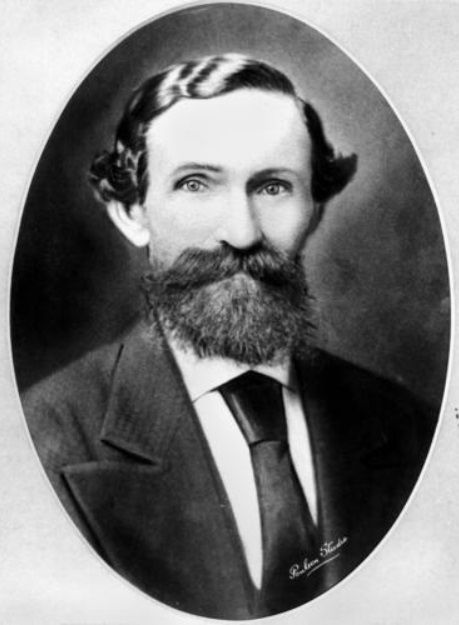
Portrait of John Murtagh Macrossan. Poulsen Studio. 1887. John Oxley Library, State Library of Queensland

After pursuing a mining career in Victoria, NSW and New Zealand, Macrossan took on the role of second in charge of John Mackay’s 1860 expedition that explored the area north of Rockhampton to where the city of Mackay now stands.

By the age of 33 Macrossan had moved to the goldfields of north Queensland and by 1871 had become a leading figure and spokesperson for miners’ rights. A fiery personality with a fierce loyalty to his fellow miners, Macrossan organised the Ravenswood Miners’ Protection Association, which petitioned the Minister for the removal of Goldfield Commissioner T.R. Hackett. In the same year, Macrossan himself was fined for publicly horsewhipping Hackett for alleged defamatory comments. Macrossan’s popularity increased because of this incident.

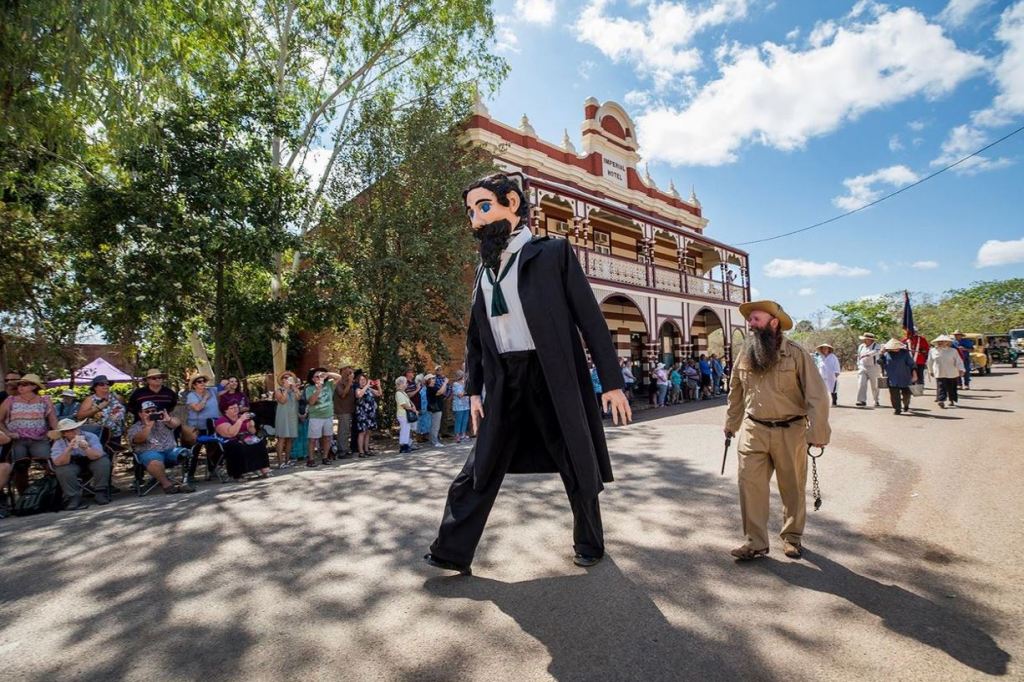
A giant puppet of John Macrossan, Member for Kennedy in the Queensland Legislative Assembly from 1873, led the 150th anniversary parade down the main street of Ravenswood on 8 October 2018

In 1872, Macrossan divided his time between Ravenswood and the new goldfield of Charters Towers.  In June 1872 he chaired a meeting called to form a Miner’s Protection Association at Charters Towers. Macrossan’s political base in Charters Towers was the large Irish population of Millchester township, many of whom had moved over from Ravenswood.

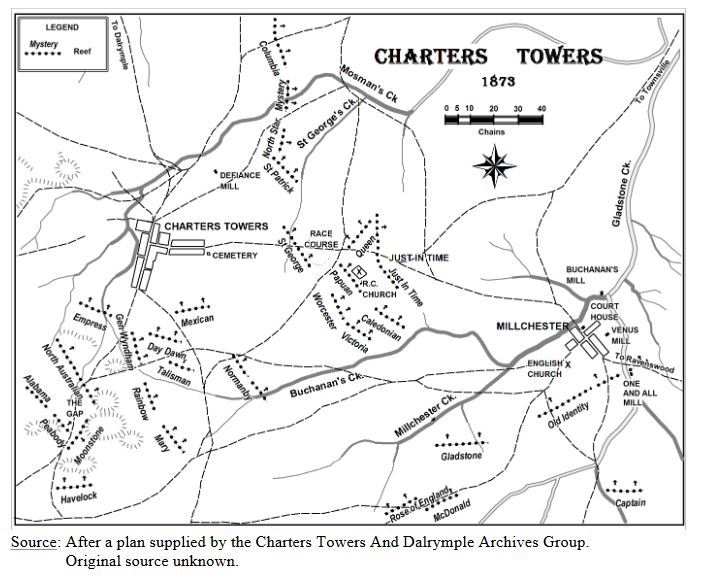
Map of Charters Towers goldfield in 1873

At a public meeting in February 1873, John Murtagh Macrossan encouraged Charters Towers miners to register on the Electoral Roll. The recently enacted Electoral Redistribution Act of 1872 would then entitle them to return a representative to the Queensland Legislative Assembly.  Macrossan did not suggest at any point that he would be a candidate, but the thrust of his discourse was that a local representative would give the diggers the representation they deserved, and that theirs would be the dominant voice in the North Kennedy. 

On 19 July 1873, Macrossan gave the Millchester township its newspaper, when he published the first issue of The Northern Advocate and Miners’ Journal.  Possession of a newspaper in his electorate gave to Macrossan an invaluable platform, and to the predominantly Irish township a vehicle to express its rivalry with Upper Camp township. 

For the next few years Thadeus O’Kane, editor of the Northern Miner and John Murtagh Macrossan, through their journals, were to fight the battle of their rival townships to a finish. In the process they made the uninhibited journalism of the Charters Towers goldfield a byword throughout the Australian colonies.

Some mystery surrounds the source of John Murtagh Macrossan’s income, but he must have had some substance to remain an unpaid member of parliament for twelve years. He certainly controlled the Northern Advocate and Miners’ Journal for some time and was rumoured to have other newspaper interests in the north. He also appears to have invested in lead mining and was involved in railway construction contracts in New South Wales and perhaps in Queensland.

Macrossan was an unshakeable representative of miners and north Queensland. In debates in the Queensland Parliament, he advanced the causes of north Queensland. He argued for a continuing cheap supply of South Pacific Islander labour for sugar planters, as long as their work was confined to the plantations, and for a tax to be removed from mining machinery. In 1886, he made an impassioned speech in favour of north Queensland’s separation from the rest of Queensland, because he did not believe the north was receiving its due in government expenditure.

Macrossan was physically small and slight, pale-complexioned and almost delicate in appearance. His deep-set eyes and heavy beard, jet black in his earlier years, attracted attention and hinted at a depth of feeling and a strength of expression to which his contemporaries all attest.

Solitary by nature, he was known to miners as ‘Jack the Hatter’ and he seems not to have made friends easily. This difficulty must have been enhanced by his intense vigour in party politics, the bitterness and passion of the speeches in and outside the House, the strength of his insistence on his Catholic religion and a clear determination not to conciliate or to suffer fools gladly.

Macrossan was seen as a champion of the worker and his support for north Queensland separation and for the mining and sugar can industries never wavered. However, Macrossan lost the seat of Kennedy at the 1878 general election, but won the seat of Townsville at a by-election on 4 March 1879 when a loyal supporter resigned in his favour.

Prior to his re-election, John Murtagh Macrossan was appointed Secretary for Public Works and Mines in January 1879. He resigned from the portfolio in 1883 because of the possibility of a conflict of interest over a railway construction project in NSW, but regained it in 1888. In 1890 he was for a short time Colonial Secretary and Secretary for Mines.

John Murtagh Macrossan possessed a magnetic personality. Though he was of frail physique he was full of energy, and his speeches exercised a remarkable power over his hearers. His language, like his mind, was simple and direct.

In February 1890, John Murtagh Macrossan and Sir Samuel Griffith attended the conference on Federation called by Sir Henry Parkes in Melbourne. Although the government resigned in August 1890, Macrossan was chosen to accompany his long-time parliamentary adversary Griffith to the Australasian National Convention at Sydney in 1891.

Macrossan’s health deteriorated seriously, but he was able to contribute two substantial speeches to the 1891 convention. He pursued the separation issue when he argued that some of the colonies were too large for good government.

“I believe also that power should be given to the Federal Parliament … to cut up, if thought necessary, the different existing colonies into smaller states … Some of the existing colonies, such as Queensland, South Australia and Western Australia, are far too large for good government.”

The effort proved too much. Macrossan had been suffering from heart disease for some years but he had an attack of bronchitis in Sydney and died during the convention on 30 March 1891. He was buried in Nudgee Cemetery, Brisbane.

John Murtagh Macrossan was survived by his wife Bridget, née Queely, whom he had married at St Joseph’s Church, Townsville, on 1 October 1874, and by a daughter and five of their seven sons. Two of his sons, Hugh Denis Macrossan (who also represented the Windsor electorate) and Neal Macrossan, along with his grandson, John Murtagh Macrossan, became Chief Justices of Queensland, while other descendants have been prominent in the law. For a person who often expressed contempt for persons who lived on the law, John Murtagh Macrossan spawned an amazing legal legacy.

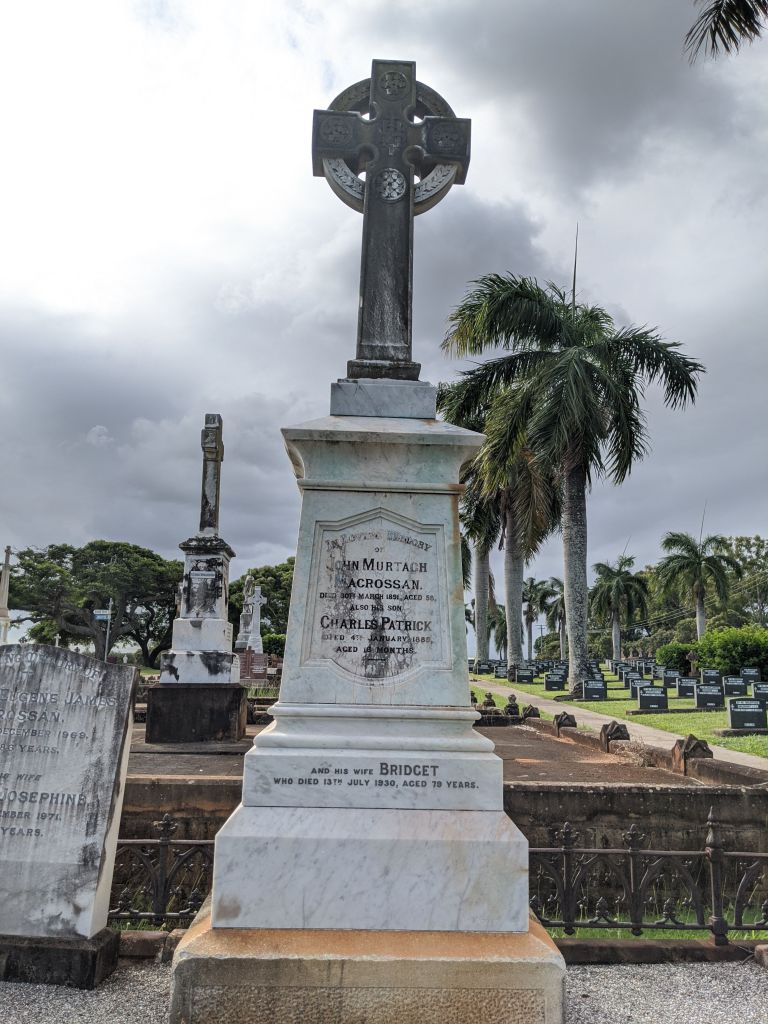
John Murtagh Macrossan’s headstone Nudgee Cemetery, Brisbane

On 7 August 1925, the Macrossan family donated £2000 to The University of Queensland, under a deed of trust, to fund an annual lecture on subjects of public interest. It was the first lectureship of its kind established in Queensland. In March 1928, the first John Murtagh Macrossan Memorial Lecturers were announced by the UQ Senate. From 1928 to 1993, Macrossan Lectures were given almost every year by distinguished Australians on a broad range of topics of public interest.

In 2023, a new annual Macrossan public lecture series was established by The TC Beirne School of Law and the UQ Law Association to be delivered in the Banco Court of the Supreme Court of Queensland to celebrate the commencement of each academic year.

King Charles III avoids victory lap of the Commonwealth

Today is the first time Queenslanders have had a public holiday to celebrate the birthday of King Charles III and yet there has been no victory lap yet of the Commonwealth. There appears to be a growing distance between the British monarch and the people of Australia.

Queenslanders took the day off work today; not in recognition of their hard work, but to recognise the British Monarch who will most likely be sleeping through the public holiday.

The first King’s Birthday public holiday in Queensland, which now commemorates King Charles III’s birthday on 19 November, is another demonstration of our denial of choice. Since his birth, Prince Charles has known he would take over the top job. Then one morning last year, Australians simply woke up to hear news from Britain that has changed our country for decades to come. Australians did not choose King Charles III as our Head of State. It is a disgraceful fact that without constitutional change, the citizens of Australia will never be consulted on our head of state.

Australian love their public holidays, even if the reason for the occasion is a little vague. For goodness sake we even have a public holiday in Melbourne for a horse race and in Brisbane for an agricultural show. Nevertheless, the purpose of the King’s Birthday public holiday is the vaguest of them all. The King’s Birthday public holiday doesn’t remind us of anything good about our country. At worst, it tells us Australia’s head of state gets the job by inheritance. The lack of any public activity around the King’s Birthday public holiday shows how the concept of monarchy is out-of-step with contemporary Australia. 

It’s time for an Australian to be our Head of State to be not only one of us but also willing to turn up.

In fact, since King Charles III became Australian Head of State he is yet to grace any of the Commonwealth nations which still call him their King with his presence.

National Director and CEO Isaac Jeffrey said:

King Charles III is King of Australia by birthright and he has held that lofty position for over a year now, yet our King hasn’t made the trip to visit us. In fact, he hasn’t been to any of the Commonwealth nations which still call him their King and Head of State. He’s visited Germany, Romania and, within the last few days, he sipped champagne in France, but he hasn’t found time for us.

Prior to becoming our King, then Prince Charles, only visited Australia 16 times. He’s fast approaching his 75th birthday. He’s had decades to travel down under to get an idea of who we are as a people and to truly understand who we are a nation. He’s only managed around one visit every five years. Some of these were extended visits, such as his days at Geelong Grammar on exchange as a schoolboy, while others like the last visit in 2018 were for only a few days – yet we still call him King of Australia.”

It beggars the question, does the monarchy take us for granted?

It’s time for an Australian to be our Head of State and do the job full-time, rather than working from home at Windsor Castle where they can’t even be bothered Zooming into the office at least once a week.

We are a unique multicultural country and we need someone who understands how to embody us, to be the guardian of our Constitution, to be a unifying symbol at home and someone we are proud to see representing us abroad. They should be elected on merit, not gifted the position by birthright. They should have the skills and work experience to do the job. The person should be one of us, responsible and accountable to us, and unwaveringly loyal to us and only us.

And, they should be willing to turn up.

In Britain, the King’s Birthday is celebrated on the first Saturday in June. In New Zealand, it’s the first Monday in June and in Canada, it’s in the middle of May. The Canadian celebration is called “Victoria Day” because it was created to honour Queen Victoria. However, over the years the Canadian holiday has changed to include the reigning sovereign’s birthday as well.

The idea of two birthday celebrations was introduced 250 years ago. Earl Charles Spencer, brother of the late Princess Diana, stated former Queen Elizabeth II received a second multiday celebration now, thanks to historical tradition.

As Spencer said, George II was

“…born in the depths of winter and they decided they couldn’t celebrate his birthday in the winter every year because there’s all sorts of pageantry.”

So, George decided he’d have a second birthday and the idea stuck.

“Anyone who’s been King or Queen of England since has a summer birthday, so that we have a hope of some sunshine.”

Since 1748, the British monarch’s official birthday has been marked by the parade known as Trooping the Colour — usually held on the king or queen’s actual birthday. But Edward VII, who reigned from 1901 to 1910, was born in November. Yet he celebrated his birthday officially in May or June because there was less chance of it being cold and drizzly during the outdoor event.

The British monarch’s official birthday celebrations (as opposed to the actual birth date) began in Australia in 1912. The monarch after Edward VII – King George V – helpfully had a birthday on 3 June. Queen Elizabeth II’s father, George VI, whose birthday was unhelpfully in December, reintroduced the tradition of an official birthday by having his official birthday on the second Thursday of June. Elizabeth II continued with this tradition. However, in 1959, after several years on the throne, she changed it to the second Saturday in June for convenience.

And yet it has always seemed absurd that Australians acknowledged the birthday of former Queen Elizabeth II at a completely different time to her actual birthday, and at different times in different states. Around Australia in 2023, the King’s Birthday public holiday continues the tradition set by the Windsor line holding the official birthday in Australia on the second Monday in June — except in WA on Monday 25 September and in Queensland on Monday 2 October.

We have our own identity as Australians. The Royals represent Britain, but cannot represent us or unite us as Australians. Australians believe in freedom and equal opportunity, not that some are born to rule over others.

We come from all walks of life, from all corners of the globe and this ancient land. Our shared commitment to our common future is what binds us together. Standing against this is the elevation of Charles III.

We can have respect and affection for Britain and its celebrity royals but still question why we do not have our own Head of State. The royals are welcome to visit as representatives of Britain, but I look forward to when the British people and their royal family will welcome a visit by the first Australian head of state.

In the words of Sammy J,

So to our King, we say g’day, and we praise his DNA, his ever loyal subjects across the sea.

We might have golden soil and a bit of wealth for toil, but us Aussies are still girt by monarchy.

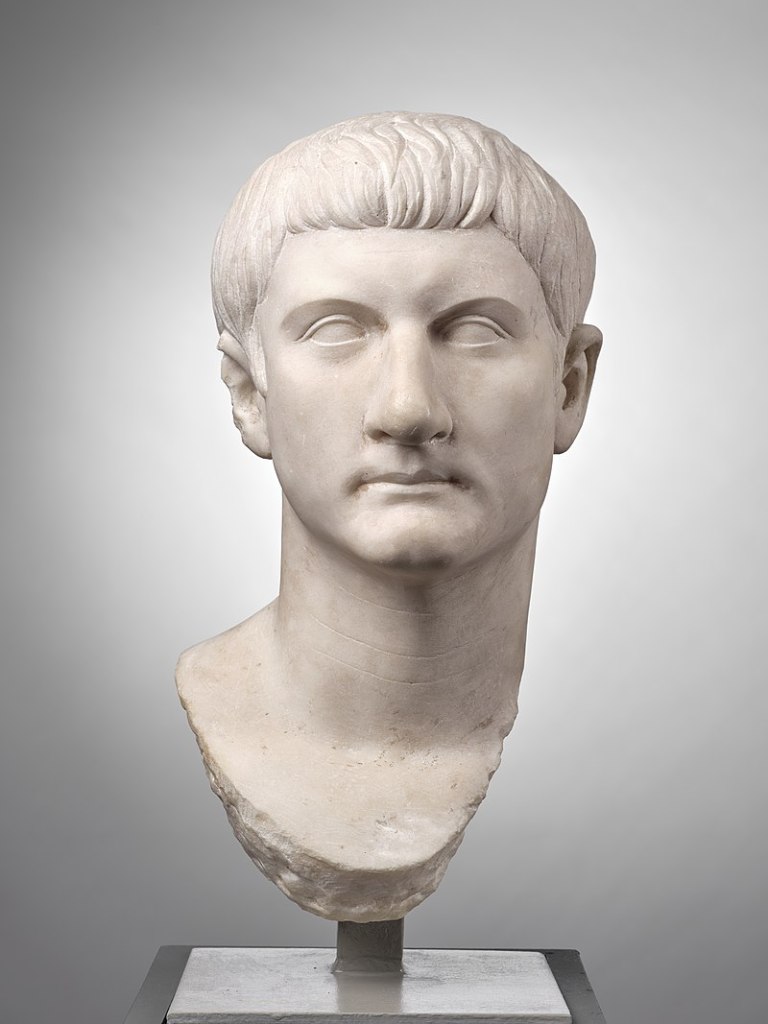
2000th anniversary of the death of Drusus the Younger

14th September 2023 is the 2000th anniversary of the death of Drusus the Younger. His death on 14 September 23 CE left the Emperor Tiberius without a direct heir following the mysterious death of his adoptive brother and cousin Germanicus in Antioch in 19 CE at the age of 34. This was ancient Rome’s ‘JFK’ moment and shook the very foundations of the Roman state.

Drusus Julius Caesar was born on 7 October 14 BCE to Tiberius and his first wife, Vipsania Agrippina. Drusus the Younger, named after Tiberius’ brother, was about the same age as his cousin Germanicus. Both of them followed parallel careers. Drusus and Germanicus held all their offices at the same age, and progressed through the cursus honorum at the same pace.

Drusus Julius Caesar

With the death of Germanicus, for which his wife Agrippina the Elder suspected murder instigated by Emperor Tiberius himself, as the son of the Emperor, Drusus the Younger became the next heir in the line of succession. Four years later, the death of Emperors son was to have considerable implications for the Roman Imperial family, especially the children of Germanicus.

Drusus died suddenly on 14 September 23 CE. Ancient historians, such as Tacitus and Suetonius, claim that he died amid a feud with the powerful Sejanus, Praetorian Prefect of Rome. They alleged that Drusus was murdered. In their accounts, Sejanus had seduced his wife Livilla, sister of Germanicus, and with the help of a doctor she had poisoned Drusus. Despite the rumours, Tiberius did not suspect Sejanus and the two remained friends until Sejanus’s fall from grace in 31 CE.

The most dangerous place in the ancient Roman world during the first century CE was within the embrace of the Roman Imperial family.

VALE – Drusus Julius Caesar

Amazing Grace is 250 years old today

New Year’s Day, 1 January 2023 marks the 250th anniversary since Reverend John Newton, a former slave trader, delivered his ‘Amazing Grace’ sermon.

Today, Amazing Grace is one of the most recognisable songs in the English-speaking world.

Amazing Grace was composed in the weeks leading up to John Newton’s New Year’s Day 1773 service at St Peter and St Paul Church, Olney in Buckinghamshire to accompany his New Testament teaching on 1 Chronicles 17:16-17 where King David said:

Who am I, O Lord, and what is my house, that you have brought me thus far?

The lyrics for Amazing Grace are an ideal subject for New Year’s Day reflection. The first verse, for example, can be traced to the New Testament story of the Prodigal Son. In the Gospel of Luke the father says:

For this son of mine was dead and is alive again; he was lost, and is found”.

The story of Jesus healing a blind man who tells the Pharisees that he can now see is told in the Gospel of John. It is here that John Newton used the words: “I was blind but now I see”.

It is also in the 2014 film Freedom where the story is told of John Newton’s composition of the Amazing Grace hymn.

https://www.cbsnews.com/news/the-story-of-amazing-grace/

In the United States, Amazing Grace became a popular song used by Baptist and Methodist preachers, especially in the American South, during the early 19th century. However, in the rest of the world, including the United Kingdom, it was largely forgotten until the mid-twentieth century.

With the folk music revival of the 1960s the trans-Atlantic traffic of musicians saw the rise of performances of Amazing Grace in Church congregations and folk festivals in Britain. The influence of Amazing Grace can be seen in it making an appearance at the 1969 Woodstock Music Festival.

From the 1960s Amazing Grace also became a favourite with supporters of freedom and human rights. During the US civil rights movement of the 1960s and opposition to the Vietnam War, Amazing Grace took on a distinctly political tone.

Amazing Grace encourages looking back at life and considering who you are now, as well as looking forward to what the future might hold.

Through many dangers, toils and snares,

I have already come

It is also about journeying back to home.

In 1970, Amazing Grace went mainstream when Judy Collins released her iconic rendition.

In 1985, Joan Baez opened the US portion of Live Aid with Amazing Grace.

On 26 June 2015, President Obama delivered the eulogy for Reverend Clementa Pinckney, one of nine black parishioners murdered by a white supremacist in a shooting at Charleston’s Mother Emmanuel Ame Church, where he called on the “reservoir of goodness”, and reflected that if we can find that that grace, anything is possible.

During the COVID-19 pandemic, Judy Collins re-released Amazing Grace with the assistance of the Global Virtual Choir comprising 1000 singers from around the world.

Amazing Grace is frequently performed on bagpipes and has become associated with this instrument ever since it became popular in a 1972 recording by the Royal Scots Dragoon Guards that became a Number 1 radio hit. At the recent Berlin Tattoo over 200 bagpipes played Amazing Grace.

There has been long-standing association of Amazing Grace with the House of the Rising Sun popularised initially by the Blind Boys of Alabama.

We could all do with a little more grace in our lives.

Texas Terror’s last flight

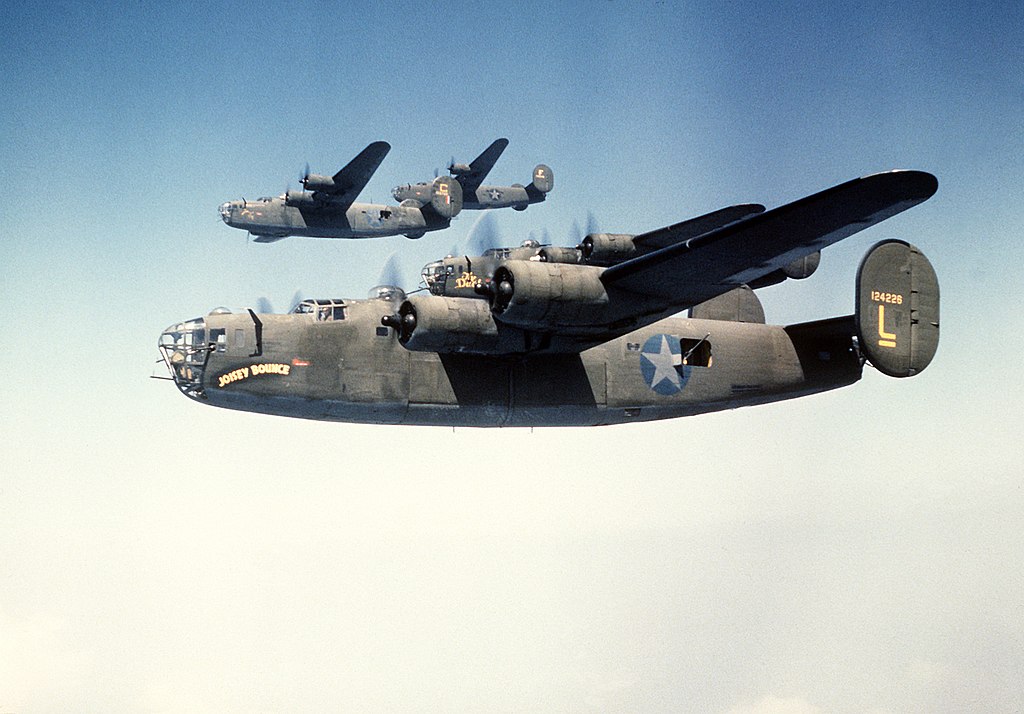
Today is the 80th anniversary of the USAAF B-24 Liberator, #41-23825, commonly known as Texas Terror, of the 400th Bomb Squadron of the 90th Bombardment Group, crashing into the southern side of Mount Straloch on Hinchinbrook Island shortly after its departure from Garbutt Field in Townsville. The accident was to be blamed on a violent storm and navigational errors.

An air-to-air left side view of four B-24 Liberator aircraft in formation. The B-24 was built for World War II combat.

On 18th December 1942 the factory-new Texas Terror B-24 Liberator was being flown from Amberley to Iron Range in north Queensland by 1st Lieutenant James Gumaer for delivery to the 90th Bombardment Group. A total of 12 persons were killed in this tragic crash. 1st Lt. Gumaer and his 4 crewmen had picked up at least 7 passengers at Garbutt airfield in Townsville on their way to Iron Range.

This was the fourth B-24 (and crew) that the 90th Bombardment Group had lost in almost as many days.

18th December 1942 was to be the last day of their war for the crew of the Texas Terror, a B-24 Liberator belonging to the United States Army Corps 90th Bombardment Group. The day dawned hot and overcast. The tropical low that had halted air operations all along the coast for nearly a week was beginning to lift. Although flying conditions in some places and at some times would be marginal at best, the war would not wait.

From soon after first light, Garbutt Air Base, Townsville began to accept and despatch aircraft that had spent a week weather bound along the coast, from Brisbane, 800 miles to the south of Townsville, to Iron Range, 500 miles further north.

Conceived in the panic days between the Battles of the Coral Sea and Midway when it appeared that the advancing Japanese would overrun New Guinea, the airstrip at Iron Range was a dusty red scar gouged in the rain forest on the eastern coast of Cape York, a temporary pierced-steel-planking strip from which the 90th Bombardment Group entered the war in mid-November 1942. For the 90th, Iron Range was a harsh initiation to the rigors of a tropical campaign.

Most of the 90th’s aircraft had been grounded by the weather between 14 and 18 December, 1942. On the 15th December, 1942 a B-24 left Iron Range for Garbutt to collect a load of bomb fuses and flares. One of the crew, Staff Sergeant F.A. Matthews noted laconically in his diary:

Ran into bad weather on the way down. Mighty rough. We were grounded here until 18 December”.

About 10.30am on the morning of 18 December 1942, Matthews flew out of Garbutt to return to Iron Range. He makes no mention of the weather in his account of the return flight; presumably it was clear on their track and at their time of flight along the Queensland coast between Garbutt and Iron Range. An hour after they arrived they were away on a mission over New Guinea during which the weather claimed a 400 Squadron aircraft. Several others on the strike were forced back by a ferocious snowstorm over the Owen Stanley Ranges.

Some northbound aircraft that day passed Garbutt without landing. Captain Everett Woods and his crew had spent a month hanging about in Brisbane waiting for an aircraft. On 18th December 1942, they finally boarded their brand new B-24 and took off from Amberley outside Brisbane for Iron Range. It was very nearly their last flight. As Captain Woods reported:

… passing Townsville, we encountered bad weather, so I dropped down to sea level in an attempt to fly along the coast, but the visibility was zero, and there were so many mountains to the left of us, I proceeded to head out to sea. At 3000 feet I levelled off, not wishing to get too far from shore, and took up my old heading. Twenty minutes passed (blind) when my navigator screamed into the interphone that we had just missed a mountain on our right. This meant that for 20 minutes I had been flying over land that was covered with 4000-foot hills, while I was at 3000 feet. I immediately hit the throttles, increased the RPM and climbed out of danger, expecting at each moment to crash into an unseen mountain”.

1st Lieutenant James Gumaer also took off from Amberley on the morning of 18th December 1942, ferrying another new B-24 to Iron Range. Gumaer was the operations officer of 400 Squadron. After bringing a B-24 across the Pacific in early November 1942, he had taken part in several operations out of Iron Range. His crew on that December 1942 morning were Second Lieutenant Dewey Hooper (co-pilot), Second Lieutenant David Lowe (navigator), Technical Sergeant Waldo Kellner (engineer) and Staff Sergeant Walter Haydt (radio operator).

The aircraft that Gumaer was delivering was B-24 41-23825, built by Consolidated at its San Diego plant, the first of a run of 25 B-24 D-7’s. The Army Air Corps had taken delivery of her on 20th August 1942, at a cost to the US taxpayer of $287,276. On 3 November 1942, Gumaer and his B-24 left Hickham Field for the long flight across the Pacific Ocean. While the B-24 was at Amberley she had been modified by strengthening the nose strut. In the fashion of the day she bore a nickname, Texas Terror.

During the flight north along the east coast of Australia, Gumaer was diverted into Garbutt. The purpose of the diversion can only be guessed but while the crew were on the ground they collected a group of passengers for Iron Range, transients drawn from various arms and services scattered along the route to New Guinea.

The most senior of the passengers was Colonel Carroll Riggs, a West Pointer commanding the 197th Coastal Artillery. He had held the appointment since 26 June 1942 when the regiment had been deployed to protect Perth from Japanese aircraft. The regiment was now fulfilling the same function in Townsville but two batteries had been deployed to Iron Range. Colonel Riggs was paying his first visit to these detachments.

Accompanying Colonel Riggs was Lieutenant Raymond Dakin, also of the 197th, carrying money for the gunners who had not been paid since August 1942.

Captains Peter Kiple and Carl Silber were both members of the 8th Fighter Group stationed at New Guinea.

Lieutenant John Cooper was on attachment to the 19th Bomb Squadron, 22nd Bombardment Group.

The last member of the services to board the aircraft was Technician 4th Grade Michael Goldstrop of the 1156th Quarter Master Company.

One civilian completed the passenger list. He was Robert Trevithick, a representative of the Pratt & Whitney Division of the United Aircraft Corporation whose motors powered the B-24.

At a quarter past eight on the morning of 18th December 1942 the Texas Terror lifted off from Garbutt, disappeared into the overcast sky and passed from the knowledge of all people.

Searches were started immediately but no trace of the big bomber was found. Two clues came from civilian sources. About nine o’clock that morning while Ingham, 70 miles to the north of Townsville, was being lashed by a heavy storm, the residents heard an aircraft circling overhead. At roughly the same time the inhabitants of the small coastal settlements near Ingham reported having seen a flash high on the face of Mount Stralock on Hinchinbrook Island, just off the coast.

For several nights from then on there were reports of a flashing light on the shoulder of Mount Stralock. Workers in a nearby sugar mill claimed that in certain conditions they could see reflections from metal on Mount Stralock. The American and Australian authorities discounted these sightings. They considered the missing Texas Terror aircraft would have been much further north by 9am on the day she went missing.

The search was abandoned a month later. Hinchinbrook Island is extremely rugged, covered with dense tropical rainforest and uninhabited. The discovery of the missing aircraft might, except for the remotest of chances, have been delayed indefinitely.

It wasn`t until late in 1943 that Aborigines reported to authorities that they had discovered burnt US currency whilst scratching for tin in the creeks at the southern base of Mount Straloch on Hinchinbrook Island.

A search party found the plane on 7th January 1944 and the remains of the crew were removed and interred in the US Armed Forces Cemetery at Ipswich before they were disinterred and interred as a group at Fort McPherson National Cemetery, Nebraska.

Amongst the debris was also found a red stiletto heal shoe. Its presence is yet to be explained as there were no women listed in the crew.

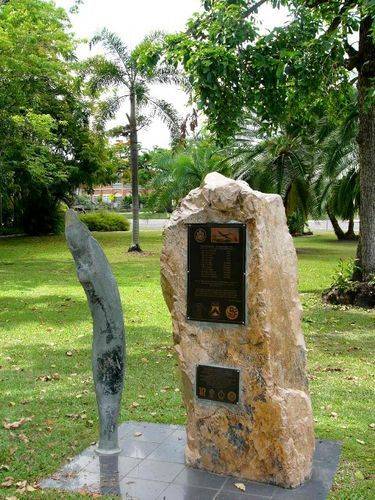
The Texas Terror Memorial in Ingham was unveiled in 1999 and commemorates the American airmen who were killed in the crash of the B-24 Liberator Bomber in 1942.

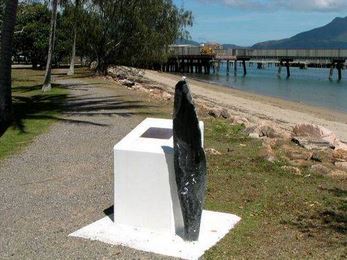
On 18th December 2002, the 60th anniversary of the crash, a memorial commemorating the victims of the Texas Terror was unveiled at Borello Park, Lucinda.

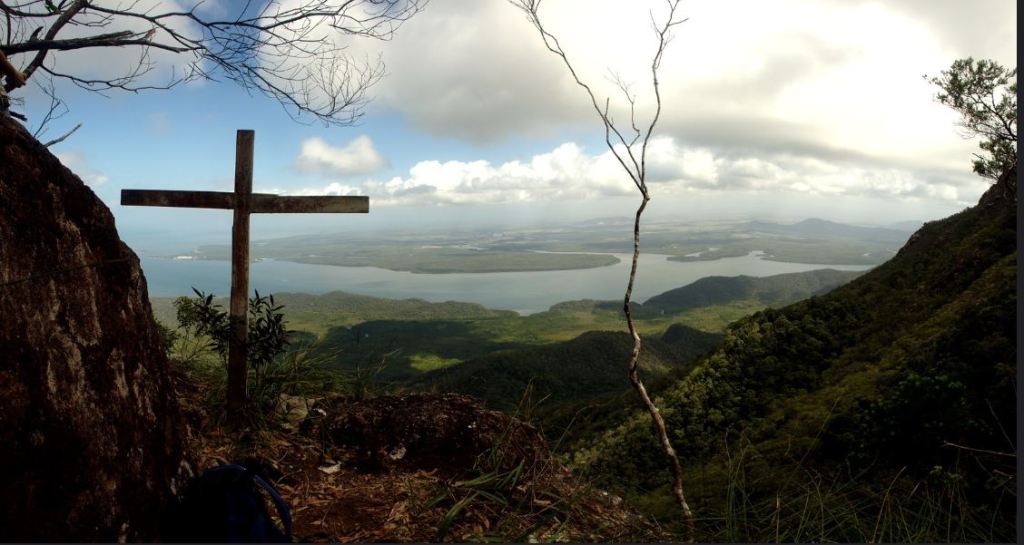
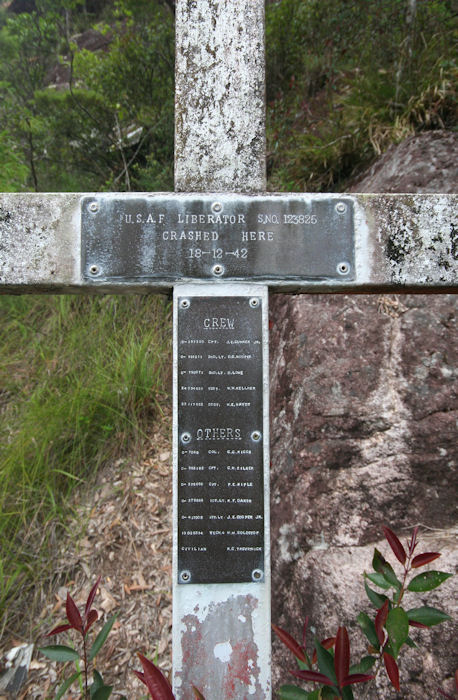
A cross has also been erected at Mount Straloch on Hinchinbrook Island.

It is as well to remember, in the grand sweep of historical events, that the fighting and dying in the Second World War was done by individuals. Many of them died far from home and found their graves in unlikely places.