
The Original Swiftie: 300th anniversary of Gulliver’s Travels

Today is 28/10/2026 and is the 300th anniversary of the publication of Gulliver’s Travels.
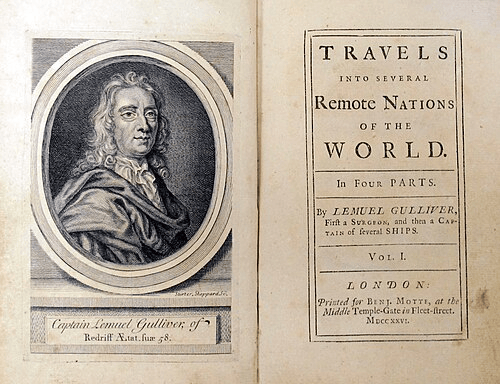
Jonathan Swift, author of Gulliver’s Travels, was an Anglican priest and Dean of Saint Patrick’s Cathedral, Dublin from 1713 until his death in 1745. The pulpit he preached from is still preserved in the Cathedral today.

Jonathan Swift was born in 1667 at Hoey’s Court close to the Cathedral. In his early years he attended Kilkenny College and then, aged 15, Trinity College, Dublin. In 1694 Swift decided to enter the priesthood and his first parish was in Kilroot in County Antrim.

Swift’s interests included English political affairs an he wrote many pamphlets on behalf of the Tory Government. Swift ultimately chose to enter the priesthood instead of politics, but his forthright political views negatively affected his chances of career progression.

Jonathan Swift hoped to be rewarded for his work championing the Tory government with a prestigious appointment in one of England’s great cathedrals. However, when the Tories fell out of favour, Queen Anne appointed him Dean of Saint Patrick’s Cathedral, Dublin instead. Swift was bitterly disappointed by this, as he saw it as virtual banishment, believing his native city to be something of a backwater.

Swift reached the pinnacle of his career as Dean of Saint Patrick’s in 1713. During his time as dean, he made the Cathedral the only Anglican church in Dublin at that time to celebrate the Eucharist every Sunday. He preached every fifth Sunday and his sermons often lasted for hours.

An urban legend suggests that the Cathedral’s pulpit originally had wheels so Swift could be pushed around through the aisles to wake up sleeping parishioners.

In Jonathan Swift’s A Sermon Upon Sleeping in Church, he wrote:

A preacher cannot look around from the pulpit without observing, that …

Of all misbehaviour, none is comparable to that of those who come here to sleep; opium is not so stultifying to many persons as an afternoon sermon

Jonathan Swift was a prolific and sometimes controversial writer. He recognised that Irish society was extremely unequal and that his best tool in achieving change was his quill.

His words were designed to provoke change, and his use of satire, sarcasm and wit attempted to shock the establishment into action. In his most famous work, Gulliver’s Travels, he satirised society, targeting a number of themes from contemporary politics and experimental science to human nature.

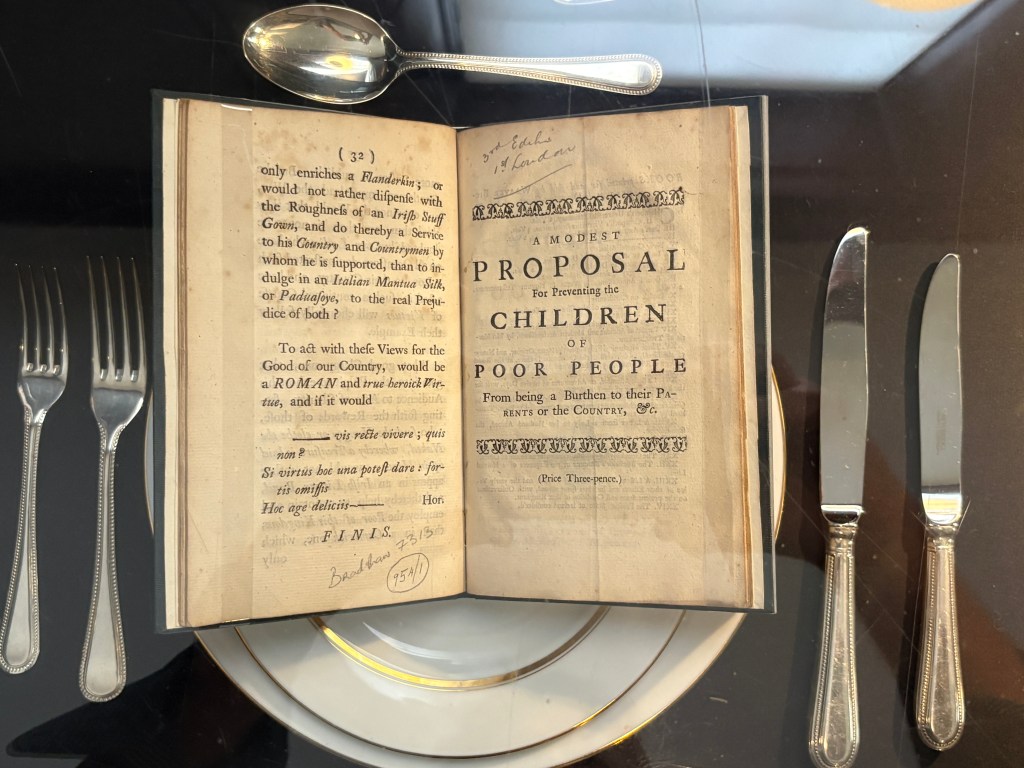
In his essay A Modest Proposal (1729), Swift mocked indifference to the plight of the Irish poor. He satirically suggested that by encouraging people to cook and eat a quarter of Irish children under two years of age, the government could solve the problems of starvation and poverty.
Swift died in 1745 aged 78, well above average life expectancy for the period.

No Daylight Savings Time for Queensland

Today the clocks moved forward an hour at 2am in NSW, Victoria, South Australia, Tasmania and the ACT. The hold-outs for maintaining natural time and resisting time casualness were Queensland and Western Australia.

The implementation of Daylight Saving Time in Queensland is a perennial issue that rears its head every 5 or 10 years. An argument for legislating Daylight Saving Time as mandatory throughout the nation is for uniformity. However, the independent approaches by states during the COVID pandemic demonstrates the strength of the Australian federation is in the pull and push tension between the federal government and the different states. We are now living in a time when the states are conscious of the importance of their individual decision-making in the best interests of the people of their states while functioning within the umbrella of the federation. This is the essence of the federal compact. If uniformity was imposed across states at a federal level then there would be no need for states at all.

In 1917 and from 1942-1944, the entire country went into daylight saving, arguably as a way of conserving fuel. Queensland again trialled daylight saving in the summer of 1971-1972. In the 1980s, the Bjelke-Petersen Government was of the view that Queensland’s geography was not suited to daylight saving.

On 2 December 1989, the sun set on 32 years of conservative rule in Queensland, when 38-year old lawyer Wayne Goss claimed victory in a Labor landslide. Goss and Labor scored a 24 seat swing, the worst defeat of a sitting government up until that time in Queensland.

The Goss Government went ahead with the daylight saving trial over the summer of 1989-1990. The daylight savings taskforce identified that the:

‘Brisbane and Moreton regions were clearly in favour of daylight saving but the other regions were not.’

More than 89% of written submissions were not in favour of daylight saving, with people citing the climate, family lifestyle, meals, television news, long days, skin cancer and primary production as reasons they opposed it. 1990 Cabinet Papers show the recommendation was the clocks only be wound forward in south-east Queensland.

In August 1990, the Cabinet agreed to introduce legislation to enact daylight saving across the state ‘on a permanent basis’. However, the legislation was not to be enacted until the end of the three-year trial extension.

A referendum on the issue held on 22 February 1992 asked the question: ‘Are you in favour of daylight saving?’ Queenslanders came back with a 54.5% “no” vote.

Election analyst Antony Green noted:

“In the 53 seats in the urban south east, the Yes vote won 60.6% to 39.4%, with the yes vote passing 70% in the southern Gold Coast. In the 36 seats covering the rest of the state, the Yes vote was clobbered 22.9% to 77.1% No.”

A Queensland referendum on the issue held on 22 February 1992 asked the question: ‘Are you in favour of daylight saving?’ Queenslanders came back with a 54.5% “no” vote.

35 years after Queensland abandoned daylight savings after a three-year trial and a failed referendum recent University of Queensland research has claimed that Daylight Saving Time is supported by 60% of Queenslanders and 70% of Brisbane residents, and therefore it should be introduced immediately. However, this is underwhelming support when considering 73% of Queenslanders live in the south-east corner, which is the only region in the State that typically desires longer days.

Daylight Saving Time will never be accepted by Queenslanders outside South-East Queensland. Queensland Premier Anna Bligh stated in 2010:

“I intend to be a Premier for the whole State – not just one part – therefore my Government will not introduce daylight saving in Queensland“.

The only option for establishing Daylight Saving Time in Queensland would require a two-zone system that may well be the catalyst for a separate state for North Queensland.

A long running joke in southern states is that non-observing states (specifically Queensland) opted out of daylight savings in 1992 because an extra hour of sunlight would confuse the cows and fade the curtains. While a little bit funny, the actual reasons are more to do with proximity to the equator and economics rather than delicate silks and bovine brains.

The implementation of Daylight Saving Time in Queensland is a perennial issue that rears its head every 5 or 10 years. It is widely considered unsuitable for Northern Australian, and any decisions to introduce it in Queensland would further the cultural, economic and political divide that already exists between the south-east corner and the rest of the State.